Sent on the Wrong Network?
A transfer exists only on the chain that recorded it. This page helps you identify that chain and choose a recovery path that fits the destination. It cannot promise that a confirmed transfer is recoverable.
Who this is for
You sent funds and the recipient says nothing arrived, or you noticed the wrong network after the transaction confirmed. Skip this page if the recipient can already see the funds on the expected network.
Before you start
- The transaction hash from Binance Wallet's History or activity list.
- The destination address, and the network Binance Wallet shows for that transaction.
- The network the recipient expected. For an exchange deposit, use the network printed on that deposit page.
- One rule: never send more funds to "unlock" or "verify" a transfer, and never share a recovery phrase or private key with anyone offering to recover it.
Steps
1. Read the network on the transaction
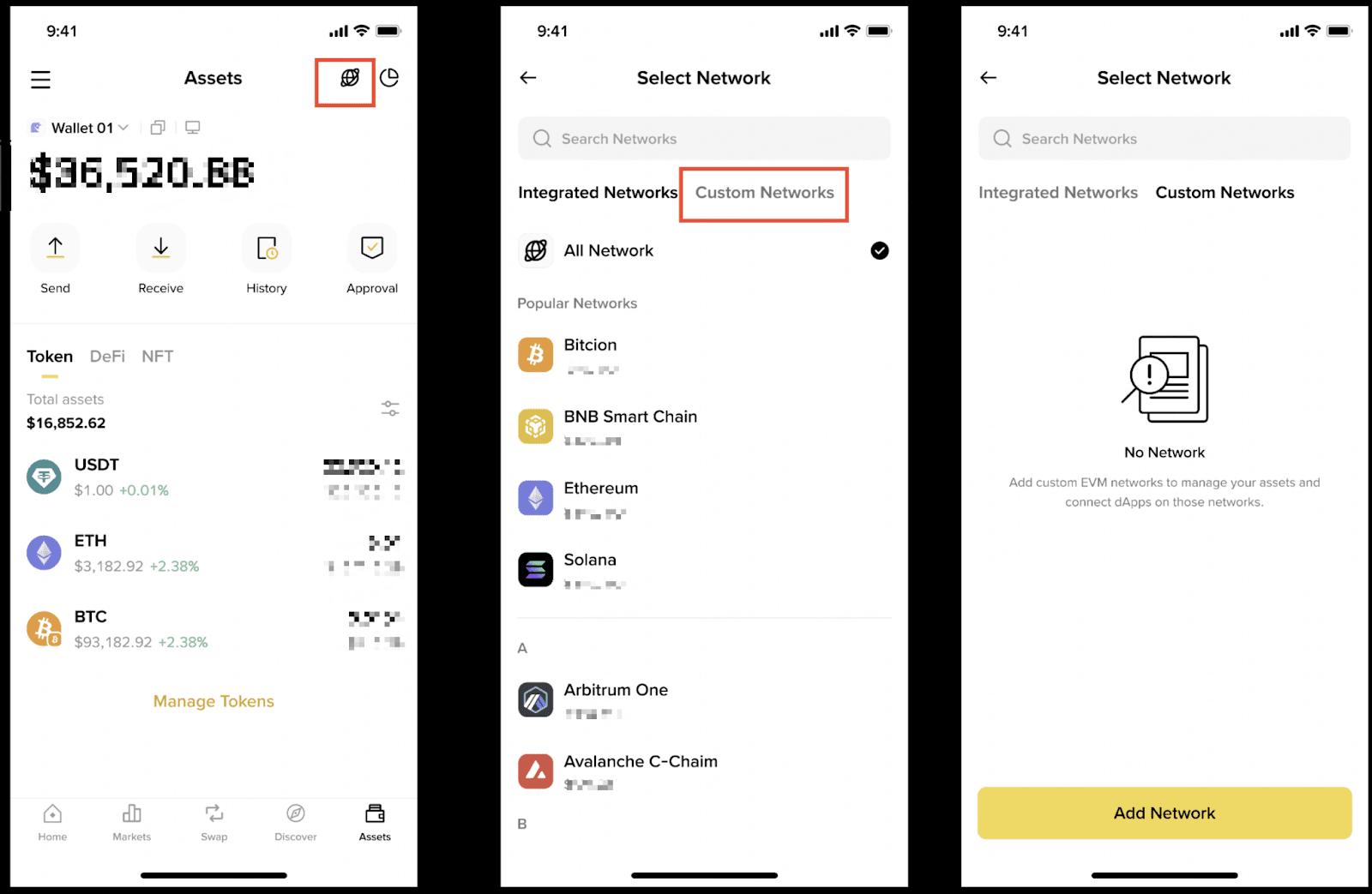
Open History on the Assets page and select the transaction. The details show the network and the transaction hash. Binance Wallet's history can be limited to transactions initiated on this device since the network was added, so use the hash and the explorer for the full record.
2. Look up the hash on the right explorer
For a Bitgold transaction, open www.bitgold.live and paste the hash. For another EVM chain, use that chain's explorer. If the hash is not found, check that you copied all of it and that the explorer matches the network in the details.
3. Match the case to a recovery path
You control the destination address. The same address can exist on several EVM chains. Restore or import the same wallet into a client that supports the destination chain, then add that network and check the balance. Moving value back to Bitgold needs a bridge or an exchange, both of which charge fees and carry risk.
The destination is an exchange deposit address. Contact the exchange with the hash, chain, amount, and deposit address. Only the exchange can credit or return the deposit, and its policy decides whether it will.
The destination belongs to a non-EVM network. Bitcoin, TRON, and Solana use different address formats, and Binance Wallet's custom-network feature supports EVM networks only. Recovery is usually impossible.
Nobody controls the destination. If the address belongs to a stranger, a burn address, or a contract with no withdrawal function, recovery is usually impossible.
4. Check the other client before you conclude
The app and extension keep separate network lists. A network added on the phone is not present in the extension until you add it there. If you restored the wallet on a new device, the network profile is also gone until you re-add it.
5. Keep a record
Save the hash, the explorer link, and any support ticket number. Do not delete the wallet: it still controls the sending address and may be needed later.
Verify it worked
Recovery worked only when one of these is true:
- The destination address shows the expected balance on the destination chain's explorer.
- A bridge or exchange transfer back to Bitgold confirms and the BTG arrives at an address you control.
- The exchange confirms in writing that it will credit the deposit.
A message from a chat account is not confirmation. Use the exchange's own support portal.
Troubleshooting
| Problem | What to do |
|---|---|
| The recipient sees nothing | Give them the hash and the network name. If it was an exchange deposit, open a ticket instead of messaging a "support" account. |
| The explorer does not find the hash | You may be on the wrong explorer or using a partial hash. Match the explorer to the network in the wallet. |
| The app shows no history for the transfer | Binance Wallet history can be limited to this device and the period since the network was added. Use the hash on the explorer. |
| You sent to your own address on another chain | Restore the same wallet in a client that supports that chain, add the network, and check the balance. Then decide whether bridging is worth the fee. |
| Someone offers to recover the funds for a fee | Decline. A confirmed transfer cannot be reversed by a third party, and a fee request is a common follow-up scam. |
Next steps
- Send and Receive BTG — check the network before the next transfer.
- What Is a Custom Network? — why the chain ID decides where a transfer lands.